
Multi-Spectrum & Fusion Optics Explained
Where the Habrok 4K Fits
Summary
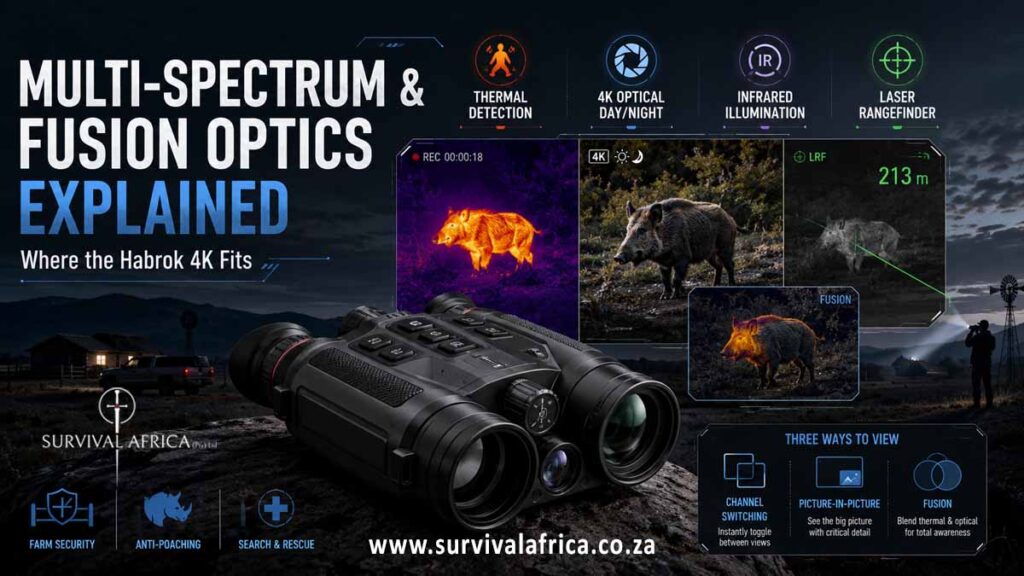
“Multi-Spectrum & Fusion Optics Explained (and Where the Habrok 4K Fits),” covers devices that combine several imaging systems in one unit rather than making you carry separate tools. It explains that a multi-spectrum device typically pairs a thermal channel (to detect heat), a digital day/night optical channel (for detail), an infrared illuminator, and often a laser rangefinder — so you can scan with thermal to find something warm, then switch to the optical channel to identify it, solving the detection-versus-identification problem from the DRI post. It distinguishes the terms that get muddled: channel switching, picture-in-picture, and true “fusion” (blending thermal and optical into one image), noting that not every multi-spectrum device does true fusion. The HIKMICRO Habrok 4K (HE25L) is used as the worked example — a binocular combining a 256×192 thermal channel, a 4K optical day/night channel, an IR illuminator, and a built-in laser rangefinder, with picture-in-picture in a rugged IP67 body. It closes on who it’s for (people who need to both find and positively identify — farm security, anti-poaching, professional search-and-rescue), who it’s overkill for (anyone who only needs to detect heat, or only observes in daylight), and the honest trade-offs of cost, weight and a steeper learning curve.
Earlier in this cluster we drew a hard line: thermal detects heat, night vision shows reflected-light detail, and serious users often want both. Multi-spectrum optics are the answer to that — one device that carries several imaging systems at once, so you don’t juggle two or three separate units in the dark.
Here’s the detail
What “multi-spectrum” means
A multi-spectrum device combines more than one imaging channel in a single housing. A typical high-end multi-spectrum binocular carries:
- a thermal channel (to detect heat, day or night, including through some light vegetation where an optical view may struggle),
- a digital day/night optical channel (a high-resolution camera for detail and colour),
- an infrared illuminator (to feed the optical channel in total darkness), and often
The point is workflow. You scan with thermal to find the warm object fast, then switch to the optical channel to identify it in detail — solving the detection-versus-identification problem we covered in the DRI post with one tool.
Multi-spectrum vs “fusion” vs picture-in-picture
These terms get mixed up, so here’s the honest distinction:
- Channel switching — you flip between thermal and optical views. Simple and effective.
- Picture-in-picture (PiP) — a small thermal inset sits inside the optical view (or vice versa), so you keep detail and heat on screen at once.
- True fusion — the device blends the thermal and optical images into a single combined picture, overlaying heat onto detail. This is the most advanced approach and not every “multi-spectrum” device does it; many use switching and PiP instead.
Don’t assume “multi-spectrum” automatically means true blended fusion. Check the exact behaviour of the specific model.
A real example: the HIKMICRO Habrok 4K (HE25L 2.0)
The Habrok 4K is a good illustration of the multi-spectrum idea in a binocular form. On the HE25L model, it combines:
- a 256×192 thermal channel (uncooled, 12μm pixel pitch, under 35mK NETD) with a 25mm thermal lens,
- a 4K UHD (3840×2160) digital day/night optical channel on a 60mm lens, with 5×–22× zoom,
- a detachable infrared illuminator for night use, both with 940NM and 850NM ability
- built-in GPS
- built-in magnetic compass
- Photo and video recording
- link via Wi-fi to mobile phone
- a built-in laser rangefinder (roughly 10–1,000m, ±1m), and
- a large OLED display, picture-in-picture, on-board recording and app connectivity, in an IP67-rated body.
The binocular form has a real practical edge over a monocular: two eyes is steadier and far less tiring on a long glassing session. In one device you can detect a heat source with the thermal channel, confirm what it is on the 4K optical channel, and measure the distance to it — without swapping kit.
(Specs vary by Habrok variant — confirm the exact model and figures on the product page before ordering.)
Who a multi-spectrum device is (and isn’t) for
A strong fit if you:
- need to both find and positively identify what you’re looking at — farm security, anti-poaching, professional search-and-rescue,
- want to carry one device instead of three,
- value the rangefinder for distance-critical work.
Probably overkill if you:
- only need to detect heat sources (a good thermal monocular is lighter and cheaper), or
- only ever observe in daylight (a quality optical binocular does that better for less).
The trade-offs are honest ones: multi-spectrum units cost more, weigh more, and have a steeper learning curve than a single-purpose device. What you buy is convenience and capability in one package. Whether that’s worth it comes down to whether you genuinely need both detection and identification in the same outing.
Browse the full range of thermal and multi-spectrum binoculars here.
Frequently Asked Questions
A multi-spectrum binocular combines more than one imaging channel in a single device. It typically includes thermal imaging and a digital day/night optical channel, often together with an infrared illuminator and laser rangefinder.
Not always. Fusion blends thermal and optical information into one combined image. Many multi-spectrum devices instead allow you to switch between channels or use picture-in-picture.
If you only need to detect heat, a thermal monocular is usually lighter and cheaper. If you need to both detect and identify a person, animal or object during the same outing, a multi-spectrum device can justify the additional cost.
About the authors.
Survival Africa (www.survivalafrica.co.za), based in Yzerfontein on the West Coast, specialises in thermal and multi-spectrum optics. Johan Dempers (ex–South African Defence Force, security and logistics) and Muldene Dempers (an experienced expedition traveller) founded the company to deliver dependable equipment and practical training for protection, mining and search-and-rescue work.
Considering a multi-spectrum unit? Talk to us first — it’s a bigger investment and worth getting right.