Brand name alone won’t tell you which unit is right. This guide compares selected HikMicro and Pulsar monoculars and binoculars the way a buyer should — by exact model, detector, sensitivity, ranging and current South African asking price, using manufacturer specifications rather than marketing claims.
Choosing the right thermal monocular is not about buying the most expensive model. This practical South African buyer’s guide compares HIKMICRO thermal monoculars from entry-level 256 units to high-resolution 640 models, including the Lynx LQ35 3.0, and explains how resolution, NETD, focal length, field of view, terrain, distance and budget should influence your choice.
Thermal and night vision are surrounded by half-truths — some from films, some from confident advice at the braai. Here are eight of the most common, sorted out honestly, with links to the fuller explanations elsewhere in the Ranger’s Notebook.
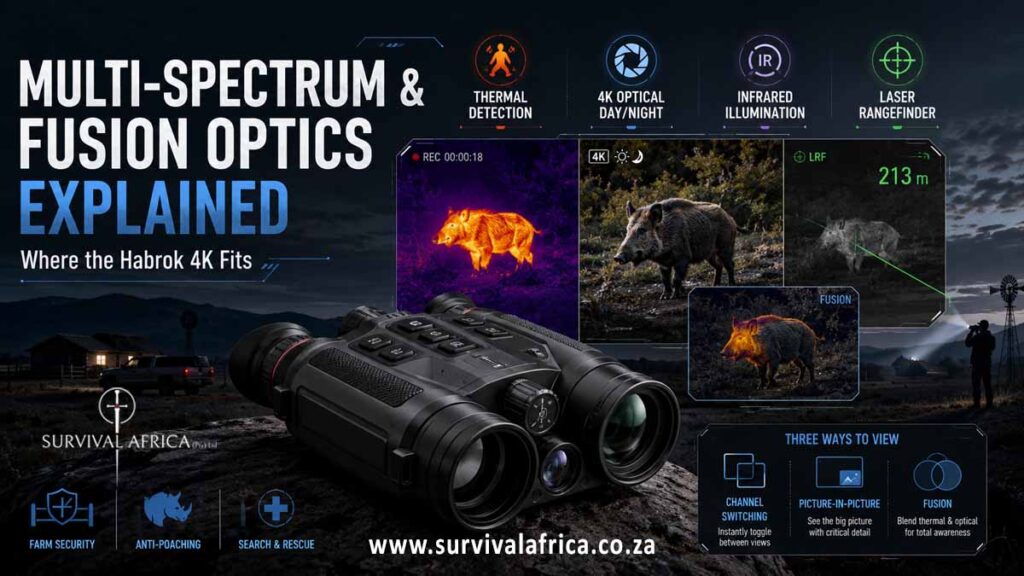
Earlier in this cluster we drew a hard line: thermal detects heat, night vision shows reflected-light detail, and serious users often want both. Multi-spectrum optics are the answer to that — one device that carries several imaging systems at once, so you don’t juggle two or three separate units in the dark.
You’ll see it on every thermal spec sheet: “Detection range: 1,800m,” or 2,600m, or some other big, reassuring number. It sounds like the distance at which the device is useful. It isn’t. Understanding why will stop you overspending on the wrong thing — or under-buying and being disappointed.
Two thermal monoculars can have wildly different price tags and look almost identical on paper to a newcomer. The difference is buried in the spec sheet. Here’s how to read one so you’re paying for performance you’ll actually use — not a number that looks impressive on the box.
When people say “night vision,” they usually mean the classic green image from the movies. But there are actually two very different technologies that both get called night vision, and they work in completely different ways. Neither of them is the same as thermal imaging — and knowing the difference stops you buying the wrong tool.
Thermal imaging feels like magic the first time you use it — a person standing in pitch darkness glows like a lightbulb, an animal hiding in thick bush lights up against the cold veld. But it isn’t magic, and understanding the basic principle helps you use one properly and buy the right one.
Thermal imaging is one of the most effective ways to spot people, animals and vehicles around a farm after dark. A big part of why some devices perform better than others comes down to a spec called
NETD — a measure of how small a temperature difference the sensor can actually pick up. Lower NETD generally means better sensitivity, particularly on humid nights, in light mist, or when there’s a lot of vegetation in the way. But NETD is one piece of a bigger puzzle.