
Thermal Imaging vs Night Vision: Which Does Your Farm Need?
A practical buyer’s guide for South African farmers, game ranchers, and wildlife enthusiasts — from Survival Africa.
If you’re weighing up thermal imaging against traditional night vision for predator control or farm security the honest answer is: it depends on what you’re trying to see, and when. Below is a straight breakdown to help you decide, based on what matters in the field — not marketing spec sheets.
The core difference
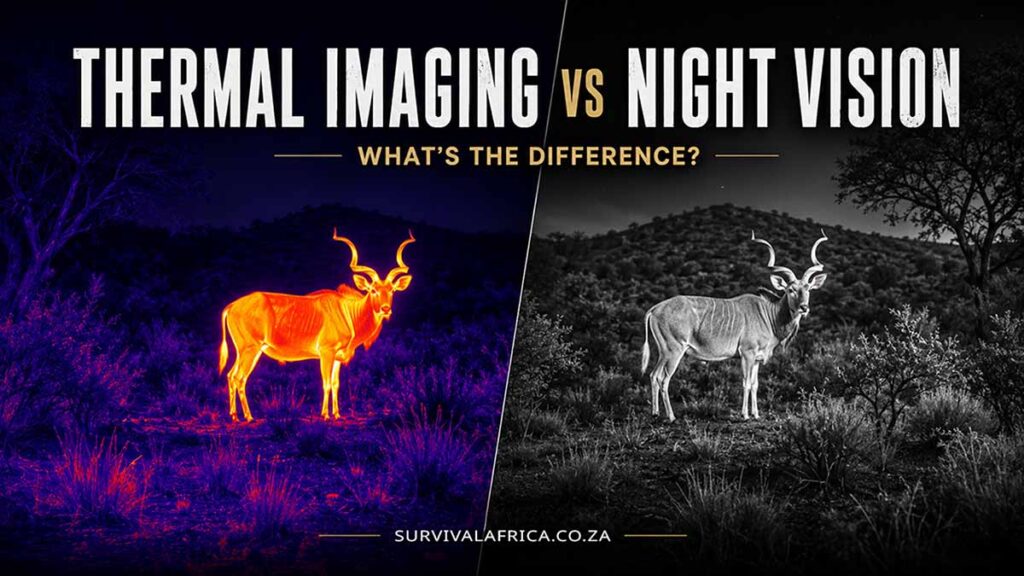
Thermal imaging detects heat, not light. It shows you a warm body — jackal, caracal, human, livestock — against a background with a different temperature, regardless of whether there’s any light at all: pitch black, certain vegetation, or fog to a certain degree. It can’t be defeated by darkness or camouflage, but the visible detail depends on the resolution of the unit.
Night vision (NV) amplifies existing light — moonlight, starlight, or an IR (Infra-Red) illuminator — to produce an image. It gives you a clearer, more natural picture with more recognisable detail (you can identify the animal, read a tag, see terrain features), but it needs some light source to work with, and it can be defeated by total darkness (without IR), heavy cloud cover, or thick vegetation.
Quick comparison
Thermal Imaging | Night Vision | |
Works in total darkness | Yes | Only with IR illuminator |
Sees through light bush/grass | Yes (heat signature) | No (needs line of sight + light) |
Detail/identification | Limited depending on resolution of unit— shape and heat only | Good — can identify species, markings |
Range for detection | Excellent (spots a body long before you’d otherwise see it) | Good, light-dependent |
Typical us case | Predator detection, perimeter/security, spotting game | Confirming detailed ID before a shot, tracking, general low-light observation |
Price range | Generally higher | Generally lower |
Questions & Answers
Thermal is usually the better first purchase. Predators move at night, often in long grass or bush where NV line-of-sight is useless, and the heat signature gives you detection distance NV can’t match. Most farmers use thermal to find the animal, then confirm identification visually or with an optic unit before taking any action.
You generally want both — thermal to detect and scan, then night vision, a top-end thermal, or a light source to confirm exactly what you’re looking at before anything else happens.
Thermal wins here too — for spotting an intruder approaching across open ground or through vegetation, heat detection at range beats anything light-dependent.
A good night vision monocular covers a lot of ground for less outlay, provided you’re working in open terrain with at least some ambient light or an IR illuminator.
Many experienced operators end up with both: thermal for detection and scanning, and a conventional or NV optic for identification and precision. They solve different problems.
No — thermal detects surface heat, so it won’t see through solid structures. It performs through some foliage, grass, light cover, and darkness, but not through solid barriers.
Rain and extreme temperature swings can reduce contrast, but thermal remains far more reliable than NV in poor weather, since it doesn’t depend on ambient light at all.
This depends heavily on your primary use case — detection range needed, terrain, and budget. It’s worth having a proper conversation about your specific farm or block before committing, since the “right” unit for a smallholding dealing with jackal differs a lot from what a large-scale cattle operation doing perimeter security needs.
About the authors.
This Ranger’s Notebook piece comes from Survival Africa (www.survivalafrica.co.za). Co-founded by Johan Dempers, whose career began in the South African Defence Force and moved through security and logistics roles across Southern Africa and the Middle East, and Muldene Dempers, whose adventures span the Amazon, São Tomé and beyond, Survival Africa exists to put reliable thermal and night-vision kit — and straight advice — in the right hands.
Browse thermal monoculars, multi-spectrum binoculars, or ask us anything.